

Here's a number worth sitting with before your next budget meeting.
At any given moment, roughly 95% of the businesses in your market are not buying anything. Research from Professor John Dawes at the Ehrenberg-Bass Institute, conducted for the LinkedIn B2B Institute, puts the share actively shopping in a given quarter at about one in twenty. Companies change providers every few years; only around 20% are in market in any given year.
Now look at where most budgets go. Overwhelmingly, at that 5%. Bottom-funnel search, retargeting, the channels with the tidiest cost-per-acquisition. Which means the vast majority of the people who will eventually buy from you are watching a brand that isn't talking to them yet — or isn't there at all.
We made a short explainer about what to do instead:
Below is the longer version of that argument.
Seasonality of attention: channels don't take turns
The instinct with multi-channel marketing is to picture a relay race. Awareness hands off to consideration, consideration hands off to conversion, each channel runs its leg and passes the baton.
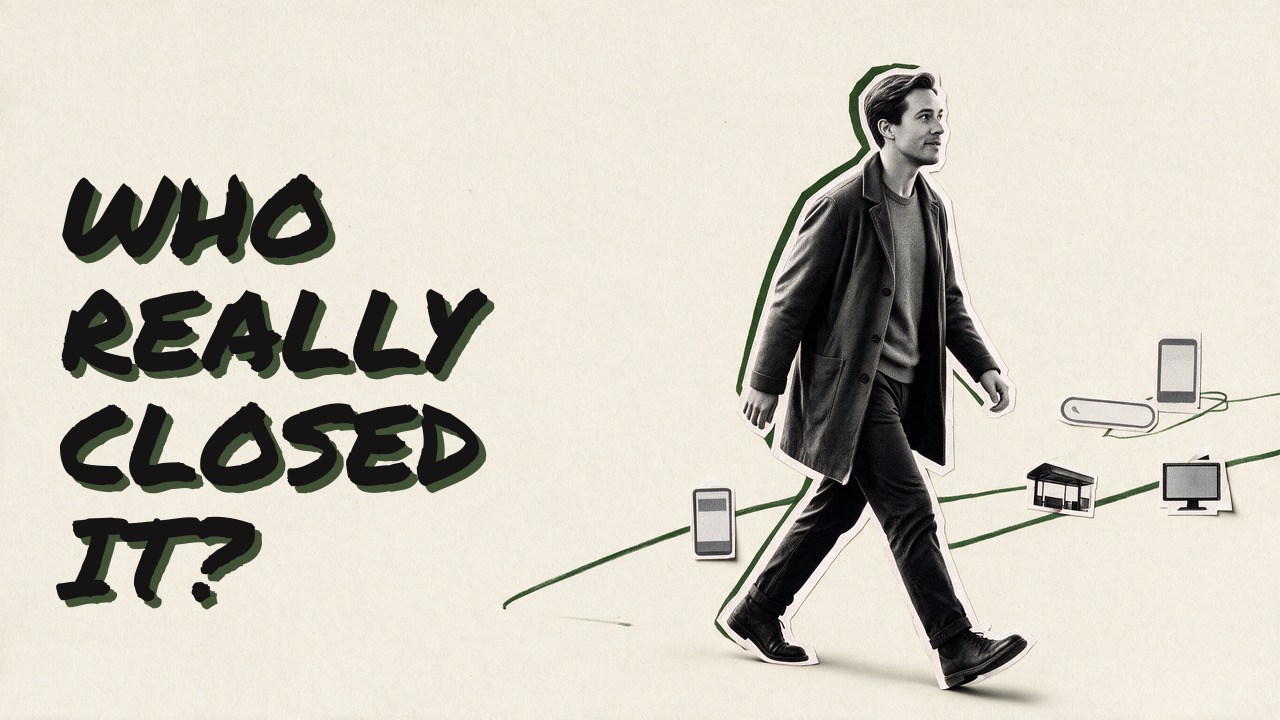
Buyers don't behave anything like that. McKinsey's B2B Pulse research found customers now use ten or more channels to interact with suppliers, up from five in 2016 — and they move between them in loops, not lines. The same buyer reads a trade publication on Tuesday, ignores you for six weeks, sees a colleague share a post, searches your category, watches a recorded webinar at 11pm, and turns up to a booth in March.
The channels aren't a sequence. They're a surface area.
Attention: paid social and publishers
Nobody wakes up looking for you. The top of the journey is interruption — a scroll past on TikTok, a post on Meta, a mention in a publication your buyer already trusts.
The mistake is judging these on last-click return. They rarely close anything, and they aren't meant to. Their job is making sure that when the buyer does enter the market, your name is already familiar. Familiarity is not a soft metric; it is the reason one of the search results feels like the obvious answer and the others feel like a risk.
This is the work that paid media and social and UGC are actually for — buying attention early, at a cost per impression you will never be able to justify with a last-click report.
Discovery: organic and paid search
Search is where latent demand becomes visible. Somebody who has been quietly aware of you for eight months types the category into Google, and the results page decides who gets considered.
Organic and paid search work as one system here, not as competing line items. Organic earns the position that signals credibility. Paid guarantees presence for the terms you cannot afford to miss. Brands that run them in separate silos with separate owners tend to bid against their own rankings and call it efficiency. Our SEO and content work is planned alongside paid for exactly this reason.
In-person: trade shows, activations, grassroots
This is the line item that gets cut first in a tight year, and it is often the one doing the heaviest lifting.
A trade show floor, a local activation, a room where somebody shakes your hand — these compress months of trust-building into a single afternoon. They're expensive per head and nearly impossible to attribute cleanly, which is exactly why they're undervalued by dashboards. The buyer who met your team in person is not the same prospect as the one who clicked an ad, even though your CRM records them identically.
Proof: webinars, content and your website
Then comes the part of the journey that happens entirely without you.
Gartner surveyed 646 B2B buyers in late 2025 and found 67% prefer a rep-free experience — and 45% used AI somewhere in a recent purchase. Buying groups are working through their evaluation independently, with fewer early sales conversations than ever.
That means your mid-funnel has to do the selling. The recorded webinar, the comparison page, the case study, the pricing explanation you'd rather have in a call — these are now the sales conversation. If a buyer can't get to a confident answer without contacting you, plenty of them simply won't contact you. Gartner also found confident buyers are twice as likely to report a high-quality deal, which makes clarity a revenue lever rather than a content chore.
Practically, this is a website and video problem as much as a sales one. The assets have to answer the question without a human in the room.
Conversion — and the attribution trap
Only after all of that does someone request a quote or place an order.
And this is where multi-channel strategy usually goes wrong inside the business. The last touch gets logged, the report gets built, and the channel that happened to be present at the finish line collects the credit. Budget follows credit. The channels that created the demand get trimmed, and six months later the pipeline thins for reasons nobody can point to on a dashboard.
The closing channel didn't do the work. It was just standing in the right place at the end.
The advocacy loop nobody budgets for
The journey doesn't stop at the purchase. It loops.
Nielsen's Trust in Advertising research consistently finds 88% of people trust recommendations from those they know above any other channel — higher than every paid format measured. Your happiest customer's offhand recommendation outperforms the ad budget that acquired them.
Which makes the post-purchase experience a marketing channel with a real return, not a customer service function. Reviews, referral moments, the reason someone brings you up unprompted — that's the highest-trust inventory available to you, and almost nobody plans it deliberately.
What this means for how you're organized
If you take one operational idea from this: your channels each have an owner, a budget and a dashboard. Your customer has none of that. They just move.
Practically, that means judging channels on their contribution to the journey rather than their individual closing rate, protecting the upper-funnel spend that last click will always undervalue, and resourcing the mid-funnel content as though it were a salesperson — because for two-thirds of your buyers, it is.
Ready to make your channels work together?
Chasing Creative plans and runs the whole surface — brand and strategy, paid media, organic and search, content and UGC, events and activations, plus the analytics to see how they actually compound. One team, one view of the journey, instead of six vendors each optimizing their own slice.
See the work, or book a call with Chasing Creative.
Sources
- John Dawes, Ehrenberg-Bass Institute, for the LinkedIn B2B Institute — the 95-5 rule
- McKinsey B2B Pulse — ten-plus channels, up from five in 2016
- Gartner, Sales Survey: 67% of B2B Buyers Prefer a Rep-Free Experience, published 9 March 2026 (646 buyers, surveyed Aug–Sep 2025)
- Nielsen, Trust in Advertising study — 88% trust recommendations from people they know
Blake Wisz is the founder of Chasing Creative, a Palm Coast, Florida marketing agency helping infrastructure, SaaS, and B2B brands grow through strategy, web, video, and paid media.

